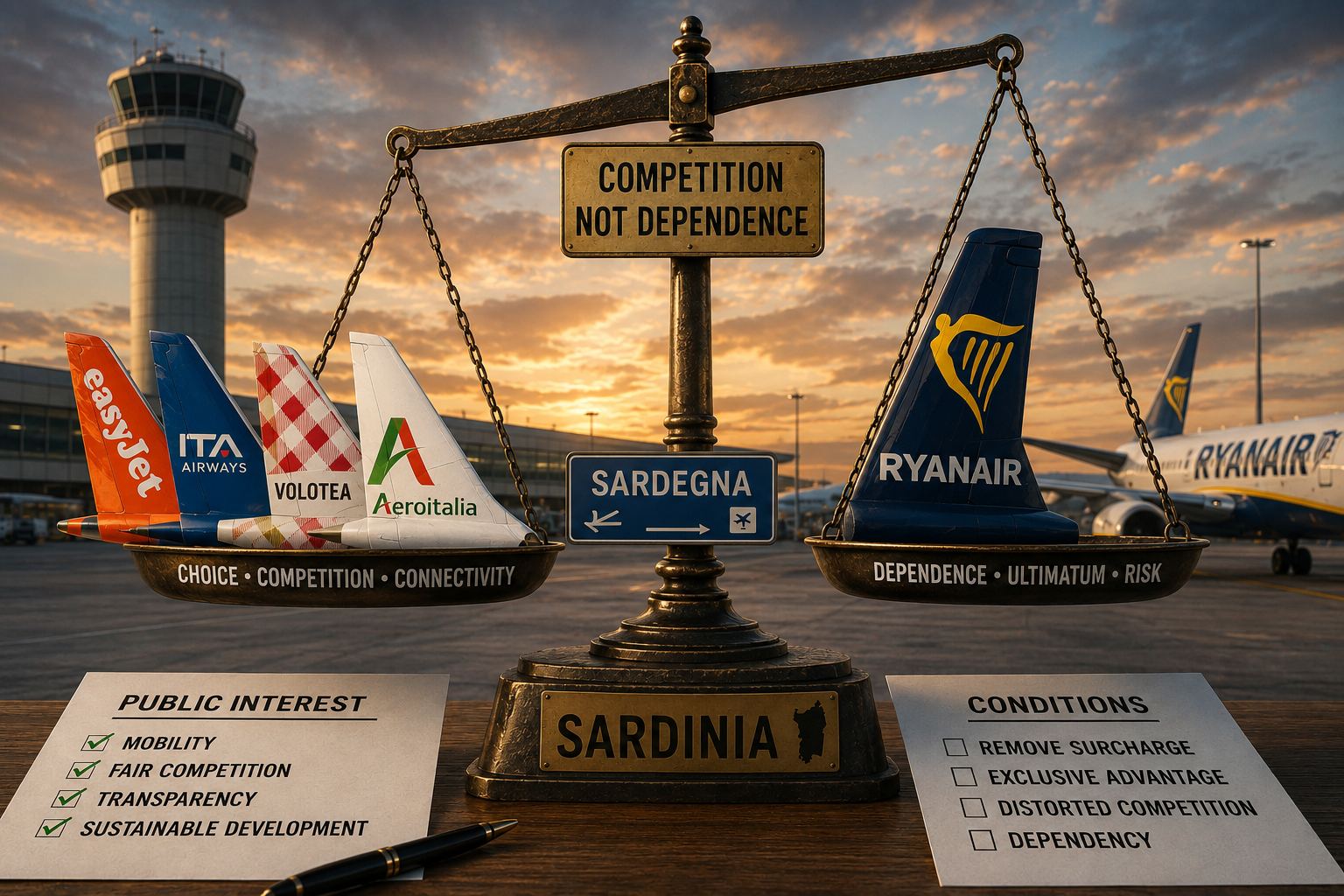
Ryanair has once again launched an attack on the Sardinia Regional Government.
It has done so in its usual communication style: impressive figures, promises of growth, jobs, hundreds of millions of dollars in investment and, inevitably, the warning that all of this could be directed elsewhere if the institutions do not accept the conditions set by the Irish airline.
In the statement issued on 13 August, Ryanair reiterated that in 2024 it had submitted a proposal which, according to the airline, would generate:
- more than 2 million additional passengers every year;
- 40% growth;
- four additional aircraft;
- $400 million in investment;
- a new base in Northern Sardinia;
- more than 900 local jobs.
All of this, however, comes with one specific condition: that the Sardinia Regional Government abolish the municipal surcharge on passenger boarding taxes entirely and throughout the year.
This is not a journalistic interpretation. These are figures and conditions set out by Ryanair itself in its corporate communications.
So far, there is nothing particularly surprising.
Ryanair is a private company. It has to generate profits and it is fully entitled to seek the economic conditions it considers most favourable for the deployment of its aircraft.
The problem arises when a legitimate commercial request is turned into something resembling an ultimatum to public institutions and, above all, when the argument is reinforced by describing Sardinia’s public service obligation routes as “unreliable” and a “waste of time and money.”
At that point, slogans should be set aside and the numbers should be examined.
Let us start with this alleged “unreliability”
Ryanair should exercise particular caution before handing out certificates of reliability to others.
The official monitoring report published by the Sardinia Regional Government on 8 July 2026, covering the first three months of the new territorial continuity regime, does not conceal the difficulties that have arisen.
But the very same report also says something Ryanair appears to overlook: as far as delays are concerned, “no emergencies have been recorded.”
As regards Aeroitalia, out of thousands of flights operated during the first three months:
- only 7 flights, equal to 0.22%, were delayed by more than three hours;
- flights delayed by more than two hours amounted to 29, equal to 0.92%.
These are not figures produced by Aeroitalia.
They are data published by the Sardinia Regional Government, namely the public authority responsible for monitoring the performance of the service and imposing penalties where breaches are identified.
That is an essential point.
Because criticising a service on the basis of objective data is one thing. Describing it generically as “unreliable” when the very public authority responsible for monitoring it states that there are no emergencies on delays is quite another.
Ryanair unquestionably has access to its own punctuality and operational reliability data for flights to and from Sardinia.
So let us do something very simple: publish them.
Let us put on the table, airport by airport and using the same methodology, punctuality, cancellations and operational regularity for every airline operating in Sardinia.
Then let the numbers, rather than press releases, determine who is reliable and who is less so.
Territorial continuity and low-cost aviation are not the same thing
There is also a much more serious conceptual error.
Territorial continuity is not designed to maximise passenger volumes.
It exists to guarantee the right to mobility of those who live on an island.
It means guaranteeing routes, capacity, frequencies and pre-established fare conditions throughout the year, including on those days, at those times and during those periods in which a purely commercial operator might consider it more profitable to deploy its aircraft elsewhere.
And this is precisely where the contradiction in Ryanair’s argument becomes clear.
The airline is effectively telling Sardinia:
Abolish the surcharge and we will deploy four additional aircraft; otherwise, that capacity may be allocated to other markets which we consider more competitive.
This is not my interpretation.
It is the very principle Ryanair consistently applies in its communications: aircraft are allocated to markets offering the most attractive economic conditions.
Fine.
That is a perfectly legitimate business decision.
But it is also the clearest possible demonstration of why territorial continuity exists in the first place.
The right to mobility of Sardinian residents cannot depend on whether, in a particular month or year, Ryanair finds it more profitable to deploy a Boeing aircraft in Cagliari, Kraków, Tirana or any other European airport.
Ryanair has every right to decide where it is more profitable to deploy its aircraft.
Sardinia has exactly the same right to decide that its transport policy cannot depend on where Ryanair happens to find it more profitable to deploy them.
But where exactly are these $400 million being invested?
Let us turn to the second figure used in the statement.
According to Ryanair, four additional aircraft amount to $400 million in investment.
This is a formula the airline has used for years.
In 2022, for example, it described the addition of a single aircraft based in Cagliari as a “$100 million investment.”
But what exactly does “investment in Sardinia” mean?
If four Ryanair aircraft are based at Sardinian airports, those aircraft do not become Sardinian infrastructure.
They are not purchased by the Regional Government.
They do not represent $400 million of fixed capital embedded in the local economy.
They remain mobile assets belonging to a private company, capable of being transferred from one airport to another in accordance with the airline’s industrial strategy.
There is nothing wrong with that.
But it would be economically more accurate to refer to the value attributed to the aircraft assigned to the base, rather than to create the impression that $400 million is actually being invested in Sardinia’s economy.
The distinction is substantial.
This is why Ryanair should be asked one very simple question:
Of the $400 million announced, how much actually represents CAPEX invested and fixed in Sardinia?
How many millions are being invested in infrastructure, property, maintenance facilities, operational centres or other physical assets genuinely rooted in the island?
And how much simply represents the conventional value assigned to four aircraft in Ryanair’s fleet?
These are two entirely different things.
And what about the 900 jobs?
The same applies to the more than 900 jobs being promised.
This too is part of a well-established communication methodology.
In 2016, when announcing 1.4 million annual passengers in Cagliari, Ryanair referred to approximately 1,000 jobs being “supported” locally.
That word matters.
“Jobs supported” and “new Ryanair employees hired in Sardinia” are clearly not the same thing.
With four additional aircraft, 900 direct hires would mean 225 new employees per aircraft.
That figure would, at the very least, require some explanation.
If those 900 jobs instead include direct, indirect and induced employment — ground handling, airports, hotels, restaurants, tourism and economic activity generated by passenger flows — then using an economic estimate is entirely legitimate.
But it should be stated clearly.
Otherwise, an economic multiplier risks being presented publicly in a way that readers may easily interpret as 900 new jobs created directly by the airline.
So here too the question is straightforward:
How many of the 900 jobs announced would actually be new Ryanair employees hired in Sardinia?
Two million passengers: a forecast is not an investment
The same reasoning applies to the two million additional passengers.
It is certainly possible that four based aircraft, combined with additional non-based capacity, could generate a very significant increase in traffic.
But two million passengers are a commercial forecast, not an investment.
And above all, it is a conditional forecast.
Ryanair itself is saying:
abolish the surcharge → we increase capacity.
Do not abolish it → we may reduce that capacity or deploy it elsewhere.
There is already a precedent.
In September 2023, in response to the Italian Government’s decree on high air fares, Ryanair announced an 8% reduction in its Sardinian winter schedule, removing routes and cutting frequencies.
Once again, that is entirely legitimate behaviour for a private company.
But for precisely that reason, a political question becomes unavoidable:
Should a Regional Government build a transport policy, or should it permanently take part in an auction between territories competing to secure the aircraft of a single airline?
This is where the distinction between private interest and public interest becomes fundamental.
The surcharge and the issue of competition
We therefore come to the most sensitive point.
Aeroitalia intends to bring before the competent national and European authorities the competitive effects that could arise from abolishing the municipal surcharge where such a measure ends up benefiting services which operate, directly or indirectly, in the same market served by routes subject to public service obligations.
It is important to be precise.
I am not arguing that abolishing the surcharge automatically constitutes State aid or is unlawful in itself.
I am arguing that its competitive effects deserve to be assessed.
European State aid rules in the aviation sector exist precisely because economic relationships between airports, public authorities and airlines must be assessed in light of market conditions and the possibility that they may generate selective advantages or distortions of competition.
Moreover, the issue cannot be confined to the perfect overlap between two airport codes.
Cagliari-Linate and Cagliari-Malpensa, for example, are formally different routes. The same applies to Cagliari-Rome Fiumicino and Cagliari-Rome Ciampino.
But economically, they compete at least in part for the same demand: Sardinia-Milan and Sardinia-Rome.
And it is particularly significant that Ryanair itself has announced the doubling of Cagliari-Malpensa next winter, from one to two daily frequencies.
If one airline accepts, through a public procedure, obligations relating to capacity, frequency, fares and year-round continuity, while another operator competes for the same demand basin without being subject to the same obligations, any public measure capable of materially changing the relative cost structure of those two models deserves, at the very least, a competition assessment.
We are not asking for protection from competition.
We are asking for competition.
But competition also means transparent rules and non-discriminatory competitive conditions.
Then there is Cagliari. And this is where the story becomes particularly interesting
Ryanair repeatedly argues that airport costs must be reduced in order to make Sardinia more competitive.
Very well.
It should then explain the position it adopted in the tariff procedure at Cagliari Airport when the airport operator proposed a reduction in airport charges.
In July 2025, SOGAER formally launched, under the supervision of the Italian Transport Regulation Authority, a consultation with airport users concerning the revision of airport charges for the 2025-2028 period.
The Transport Regulation Authority subsequently intervened on the proposal and concluded the relevant regulatory procedure in May 2026.
As part of that tariff procedure, SOGAER reported to the Authority the opposition expressed by Ryanair to the proposed reduction in airport charges.
That is a particularly significant point and deserves an explanation.
Why?
If reducing airport costs is always, according to Ryanair, the best way to increase competitiveness and traffic, why oppose a general reduction in airport charges?
The possible economic explanation is very interesting.
A general reduction in airport charges benefits Ryanair.
But it also benefits Aeroitalia, easyJet, ITA Airways, Volotea and every other airline using that infrastructure.
In other words, it reduces costs for everyone.
A system in which a single airline can instead use its scale and its ability to shift very large traffic volumes in order to negotiate particularly favourable commercial conditions produces a very different outcome.
And this is where we reach the real issue:
Does Ryanair genuinely want lower-cost airports, or does it want to preserve the ability to secure economic conditions that are more favourable than those available to other operators, thanks to its enormous bargaining power?
These are two profoundly different things.
Ryanair’s market power is not my personal assessment
When discussing Ryanair, its achievements should first be acknowledged.
It is an extraordinary industrial machine.
It has transformed European air transport, developed airports that were previously marginal, made flying accessible to millions of people and built a cost-control capability that many competitors have never managed to replicate.
But its scale has also produced something equally evident: enormous market power and enormous bargaining power.
And this time, that is not my personal assessment.
In December 2025, the Italian Competition Authority fined Ryanair €255.76 million for abuse of a dominant position.
In the relevant market examined by the Authority, Ryanair accounted for approximately 38-40% of passengers carried across routes to and from Italy.
The Authority identified significant market power and the airline’s ability to act to a considerable extent independently of competitors and consumers.
One point must be clarified.
That proceeding specifically concerned the relationship between Ryanair’s distribution model and travel agencies, not the economic relationship between Ryanair and airports.
It would therefore be incorrect to use that decision to claim that the Italian Competition Authority found Ryanair guilty of abusing airports.
But it would be equally incorrect to ignore what the decision demonstrates about the scale and market power the Irish carrier has now achieved in Italy.
When an airline of this size says to an airport or a Regional Government:
“If you do not change these conditions, we will put the aircraft somewhere else.”
it is clearly not negotiating with the same bargaining power as an airline operating ten, twenty or fifty aircraft.
Sardinia should not have to choose between Ryanair and everyone else
This may be the most important point.
Sardinia has an interest in having Ryanair.
It has an interest in having easyJet, ITA Airways, Aeroitalia, Volotea and any other airline capable of bringing connectivity, tourists, competition and economic development.
Ryanair is not the problem.
The problem arises when Ryanair’s interest is presented as though it automatically coincided with Sardinia’s interest.
It does not.
Ryanair must maximise the return on its aircraft and the value created for its shareholders.
That is its job.
The Sardinia Regional Government must maximise connectivity, the economic welfare of the territory and the right to mobility of its citizens.
That is its job.
Those objectives can very often coincide.
But they do not necessarily coincide all the time.
And it is precisely when they do not coincide that politics is required.
So, dear Ryanair, let us compare the numbers
Two million additional passengers?
Explain how that figure is calculated and what actual capacity is expected to generate it.
Four hundred million dollars?
Explain how much of that $400 million genuinely represents capital invested and fixed in Sardinia and how much simply represents the value attributed to four mobile aircraft from your fleet.
Nine hundred jobs?
Tell us how many would actually be new Ryanair employees hired in Sardinia and how many are instead indirect, induced or merely “supported” jobs calculated through economic multipliers.
Territorial continuity routes are “unreliable”?
Publish your punctuality, regularity and cancellation data for Sardinian operations and let us compare them, using the same methodology, with those of every other airline.
Competitiveness?
Then explain why a general reduction in Cagliari Airport charges met with your opposition.
Municipal surcharge?
By all means, let us discuss it.
But let us also discuss the effects on competition when a public measure reduces the costs of services competing for the same demand basin as routes subject to public service obligations.
And above all, let us stop confusing a conditional commercial proposal with a gift to Sardinia.
Ryanair is not a charity. Aeroitalia is not a charity.
No airline is a charity.
Each airline is fully entitled to defend its own economic interests.
And that is precisely why public institutions must defend the general interest.
Competition has produced some of the greatest advances in the history of European air transport.
It must be protected.
But competition does not mean allowing the largest player to progressively dictate the conditions of an entire market.
It means ensuring that everyone can compete under transparent rules and without allowing the economic power of one operator to evolve into a power to influence infrastructure, territories and public institutions.
An airport may need Ryanair.
A Regional Government may have a strong interest in having Ryanair.
But no airport and no Regional Government should ever find itself in a position where it cannot afford to be without Ryanair.
It is a subtle distinction.
But it is precisely the distinction between competition and dependence.